
Buying Guides
Buying Guides
Charango Strings: A Five-Course Buying and Identification Guide
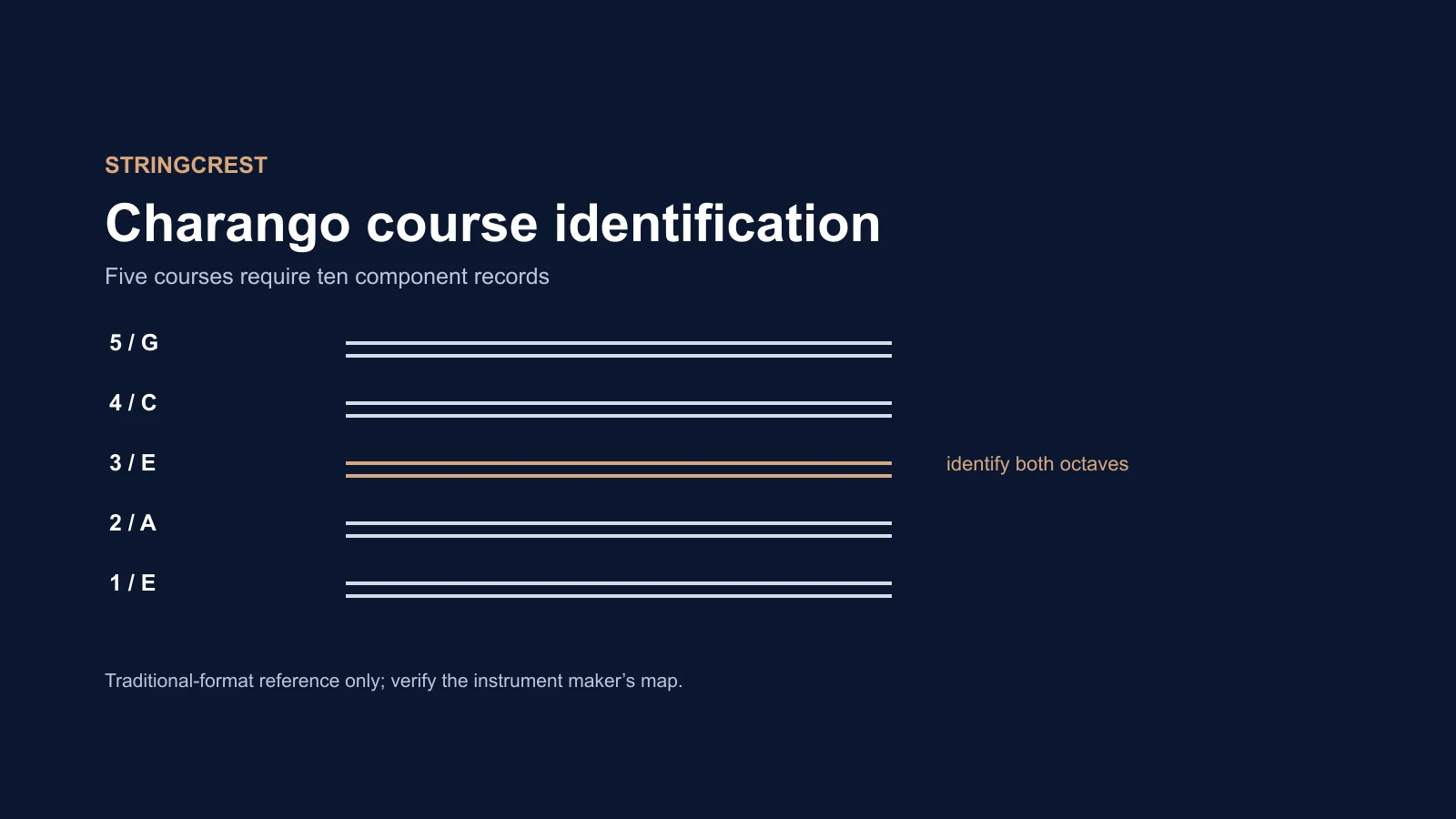
Identify a traditional charango’s five courses and ten members, including the central octave pair, before discussing a replacement or complete-set specification.
Introduction
A traditional ten-string charango request should identify five courses, ten individual members and the pitch of each member. The central course can contain an octave pair, so a list of five letter names cannot describe every component. Confirm the exact instrument before choosing strings or preparing a private-label specification.
For a dealer handling charango strings, the useful first decision is which instrument and layout the request concerns. Charango-family names, similar body sizes and a shared ten-string count can conceal different applications. This guide provides a course map and an intake method for the traditional five-course format. It does not announce a StringCrest charango SKU, set tension, scale limit or available construction.
Identify the family member before interpreting the tuning
Record the instrument maker, model or maker’s description and its actual speaking length. Ask for the stringing instructions, a photograph of the complete instrument and a close view of the course arrangement. A local instrument name is useful context, but it should not be the only product identifier in a replacement inquiry.
Aquila’s South American instrument string catalog distinguishes Charango, Hatun Charango and Charango Walaycho entries, with different composition descriptions. This is evidence that a family name needs a more precise application. It is not permission to treat all of those entries as interchangeable or to copy their specifications into another supplier’s offer.
This article concerns a traditional ten-member, five-course request. If the actual instrument has another string count or layout, establish that configuration first and use a matching record. Do not force a different family member into the ten-row table because its seller used the word charango.
State the course direction and the member order
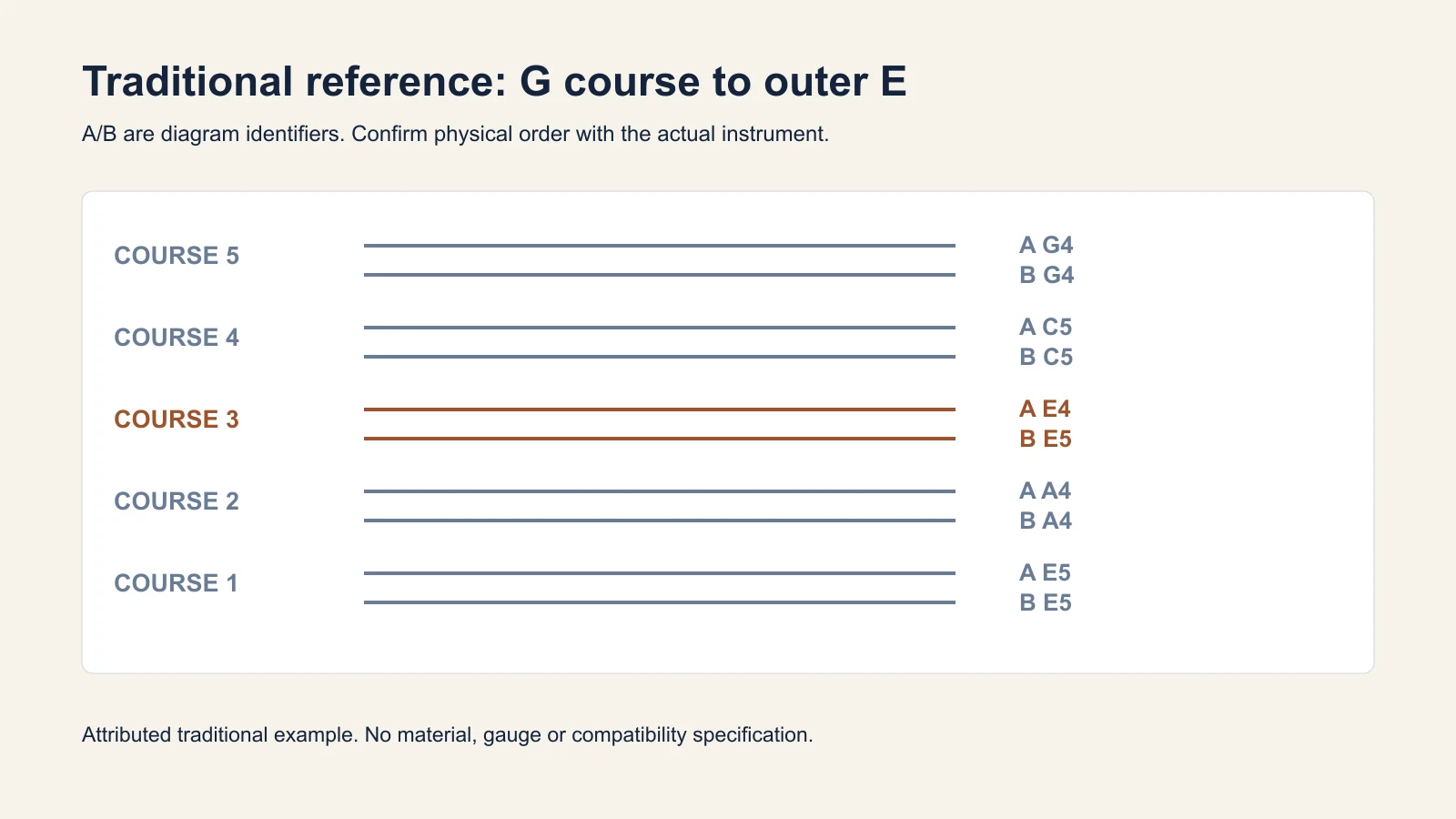
The worked reference below reads from the G course toward the outer E course. It labels those courses 5 through 1 for this diagram. A and B distinguish the two members of a course; they do not prescribe the left/right mounting order on a real instrument.
Aquila’s published traditional Charango composition identifies paired G4, paired C5, an E4/E5 pair, paired A4 and paired E5. The following expansion makes that compressed notation readable as ten component positions. It is attributed to that named traditional layout, not presented as a universal instruction for every charango-family instrument.
| Diagram course, G side toward outer E side | Member A target | Member B target | Relationship in this reference |
|---|---|---|---|
| 5 | G4 | G4 | Unison |
| 4 | C5 | C5 | Unison |
| 3 | E4 | E5 | Octave |
| 2 | A4 | A4 | Unison |
| 1 | E5 | E5 | Unison |
Use the instrument maker’s map to confirm both the actual pitches and physical member order. The A/B assignment in a worksheet must not become an installation instruction by accident. The diagram also does not specify gauges, materials, tension or the strings’ usable lengths.
Understand the central pair without sorting the whole set by pitch
The E4/E5 pair contains two different registers of the same note name. E4 is lower than E5. In the reference layout above, the pitch order therefore does not rise steadily as the course list moves from G toward the outer E. Sorting the components only by note height would lose the physical arrangement the instrument needs.
Keep three descriptions separate:
- The course is the playing group to which the pair belongs.
- The member identity distinguishes the individual components within that group.
- The target pitch includes an octave number, so two E members at different registers are not confused.
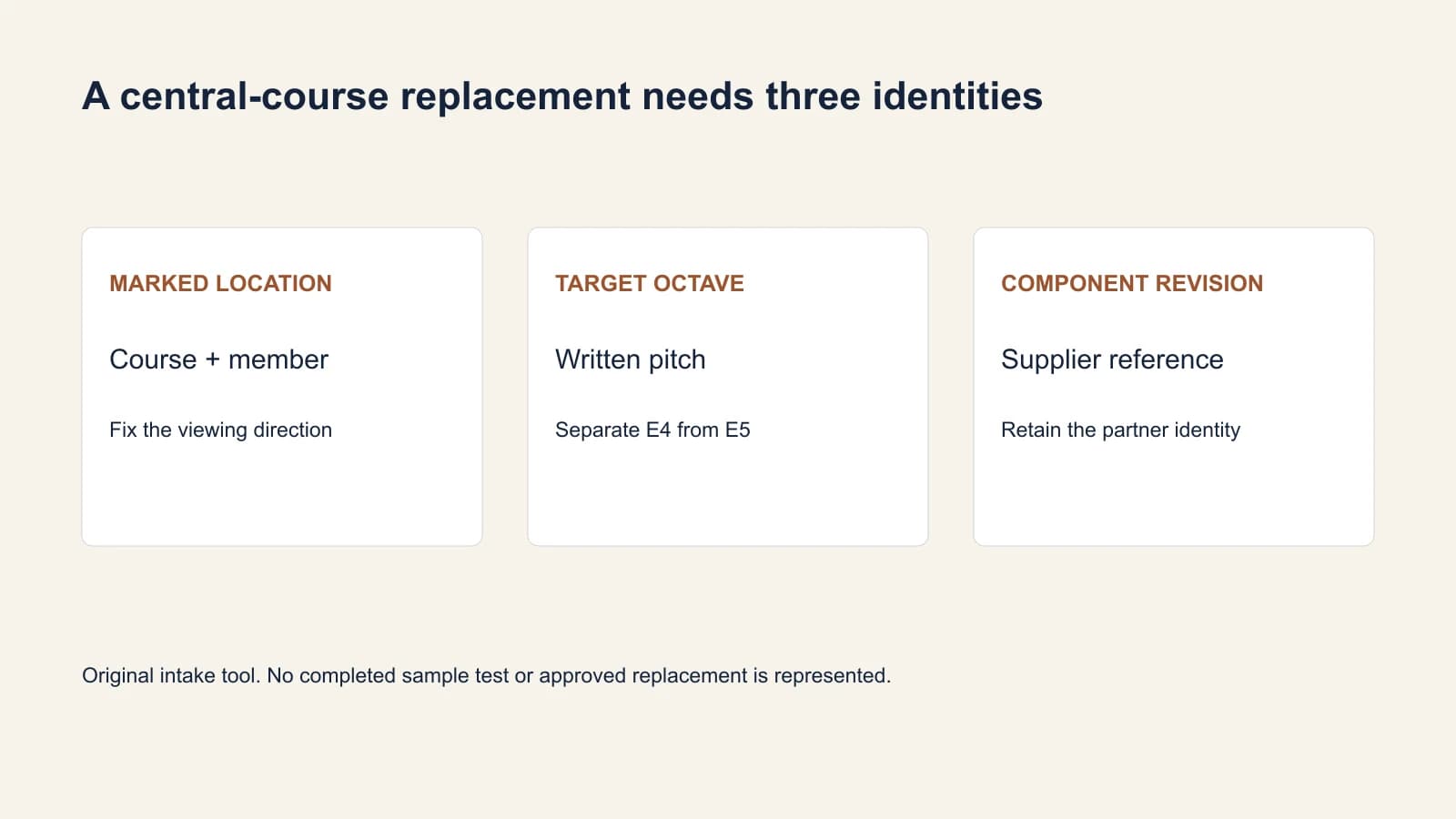
This distinction matters when a replacement inquiry says only “the middle E.” Ask which member, target octave and instrument map the customer means. A photograph with a marked position can fix the location, while the written record fixes the target. Neither should be replaced with a guess based on the string’s apparent thickness.
A course-number convention alone is also insufficient when two suppliers number from different sides. Write the direction in words, attach the marked reference and keep it with the quote and sample. The example above is intended to make that ambiguity visible, not to establish an industry-wide numbering standard.
Separate polymer descriptions from confirmed construction
The Aquila traditional Charango page identifies one proprietary synthetic material and its own product conditions. A supplier’s proprietary material name should stay attributed to that product. It does not establish that an unbranded string is chemically identical or has the same dimensions, feel or performance.
For the proposed set, request the actual material and construction for every member. Record whether it is plain or wound and how the supplier identifies it. Do not turn a general label such as nylon into a claim that all ten components have one identical diameter or target tension. Conversely, a maker’s metal-string family should not be substituted for an unidentified synthetic-string application merely because its count looks similar.
Confirm the intended attachment from the actual instrument and component instructions. The explanatory drawings here show component lines without fitted metal ends. They are not photographs of installed strings or a bridge design. If an end treatment or a knot is relevant, obtain the applicable instructions rather than improvising from a diagram.
Use a ten-member record for a proposed set
Complete the empty table for the application being discussed. Every component record should contain the target note and octave, material, finished diameter with units, usable length and endpoints, attachment requirement, and proposed item or sample code. Keep the supplier’s proposal distinct from the buyer’s request.
| Course in the declared map | Member | Requested component record | Supplier proposal | Accepted reference |
|---|---|---|---|---|
| 5 | A | |||
| 5 | B | |||
| 4 | A | |||
| 4 | B | |||
| 3 | A | |||
| 3 | B | |||
| 2 | A | |||
| 2 | B | |||
| 1 | A | |||
| 1 | B |
The empty cells are an original planning worksheet. No value has been measured or approved by filling in the row labels. A supplier can propose identical components for a unison pair or different ones for an octave pair, but the actual identities must be stated in the returned list. The word pair is not a component specification.
Record speaking length separately from the full installation path and supplied length. The path includes the actual attachment and route to the relevant tuning post. A dimension copied from a different charango-family model does not resolve that path. Ask which measurement endpoints and installation condition the proposed supplier uses.
If the supplier provides a tension description or numerical data, connect it to the precise component, pitch and length conditions. Do not calculate missing tensions from appearance, borrow another maker’s figures or assume that a category name has the same meaning across brands. A construction proposal remains a proposal until its applicable documents and sample questions are resolved.
Distinguish a complete-set request from a replacement inquiry
A complete-set request needs all ten identities and their intended pairing. A single-member request also needs the identity of the string or strings staying installed, particularly the partner in the central course. If that partner has already been replaced with an unknown component, the old package alone may not describe the current application.
A hypothetical request for “the middle E” illustrates the problem: both central members have the letter E in the reference layout, but one targets E4 and the other E5. A marked position and confirmed octave identify the request without guessing from the broken piece. That still leaves the actual material, usable length and component proposal to be established.
An importer can use a short intake note: exact instrument, marked course/member, intended note and octave, known companion components, and unresolved length or attachment questions. This is an information request, not a promise that a matching single is available. Keep actual availability and sample terms subject to the supplier’s proposal for the identified application.
For packet labeling, distinguish the course from its two members. A package that prints one course name but supplies two different-register components should make the distinction understandable to the installer. Confirm the viewing direction of any diagram. A print proof can verify the artwork’s wording, while the physical sample is needed to check what the pack actually contains.
The mandolin specification guide describes a different paired-course instrument and its own construction questions. A shared course concept does not make that set a charango replacement. Likewise, the eight-string bouzouki guide belongs to its stated instrument. Use those boundaries to keep warehouse descriptions and website categories from merging distinct instruments into one generic folk-string item.
Review the candidate on the intended instrument
After documentary identification, a competent installer can check the proposed candidate on an appropriate instrument using its maker’s instructions. Confirm the component assignment before increasing pitch. Any uncertain tuning, damaged contact point or unresolved fit question should be referred to the maker or a qualified technician.
Record the exact set, instrument, tuning and relevant setup changes with the evaluation. A useful review can establish whether that candidate fits the declared path and how evaluators describe the complete pairing under those conditions. It cannot establish a universal settling time, service life or tonal ranking for every charango.
Keep a small exception record: which component differed from the request, what was proposed instead and which decision remains open. That record can be more useful than a general assertion that the set sounded good. It tells the supplier what to revise and prevents a preferred but unidentified sample from becoming the basis for repeat orders.
FAQ
Does ten strings always mean five identical pairs?
No. The attributed traditional reference above has four unison pairs and a central E4/E5 octave pair. Confirm the actual layout rather than inferring identical components from the count.
Are charango and ronroco strings interchangeable?
The instrument-family name alone does not establish compatibility. Identify the exact instrument, pitch map, speaking length, construction and installed path, then obtain a supplier proposal for that application.
Can gauge alone identify a replacement for the central course?
No. The course member, intended octave, construction, length and actual component identity are also relevant. Use the marked map and the known companion component to prepare the inquiry.
Conclusion
A clear charango request fixes the instrument identity, course direction and all ten component records. Giving the central octave pair separate member labels prevents a five-letter tuning shorthand from hiding the information a supplier needs.
The folk and orchestral string category is a place to begin a discussion, not confirmation of a charango product specification. Send Your Ten-Member String Brief with the maker’s map, dimensions and unresolved fields so that the proposed application can be assessed accurately.
FROM GUIDE TO PRODUCT
Connect this guide to StringCrest product ranges.
Review the relevant range, then bring the instrument, complete specification and open questions into one project brief.
YOUR PRODUCT · YOUR BRAND
Discuss your next string project with Frank.
Share your instrument category, target market, gauge or material direction and private-label packaging requirements.

ABOUT THE AUTHOR
Frank Zou
Frank works directly with musical-instrument brands, importers and distributors on string specifications, product selection and private-label project requirements.
Meet Frank