
Wholesale Planning
Folk & Orchestral
Viola Strings Wholesale: A Scale, Core and Inventory Guide for B2B Buyers
A B2B method for defining viola size groups, position construction, tension labels, end fit, samples and set-versus-single inventory.
Introduction
Buying viola strings wholesale requires more detail than ordering a four-string set described only as “medium.” Viola instruments vary in body length, playing length and setup. String makers also use size labels that are meaningful inside their own product systems but are not automatically interchangeable across suppliers. A buyer therefore needs to define the reference instruments, the intended player segment, the four string positions, the core and winding system, the declared tension category, and the end and tailpiece fit before comparing samples or prices.
The main commercial risk is not that a buyer will forget the names C, G, D and A. It is that a single stock-keeping unit will be asked to cover instruments or expectations that were never included in the approval. A set may physically install but still place a winding transition in the wrong location, mismatch the intended scale group, or create an uneven response across the four positions. Packaging can then amplify the problem if it uses a broad “fits all violas” claim that the samples never established.
This guide is for distributors, importers, orchestral retailers, school-supply programs and private-label brands preparing a viola-string brief. It explains which details make quotations comparable, how to organize sample evaluation, and how to plan sets and singles without inventing universal specifications. It does not present a StringCrest model, guaranteed availability, or one correct gauge recipe. Every commercial specification still needs a current proposal, identified sample and written approval.
Define the instrument size before discussing the set
Body length and string scale are related but not identical
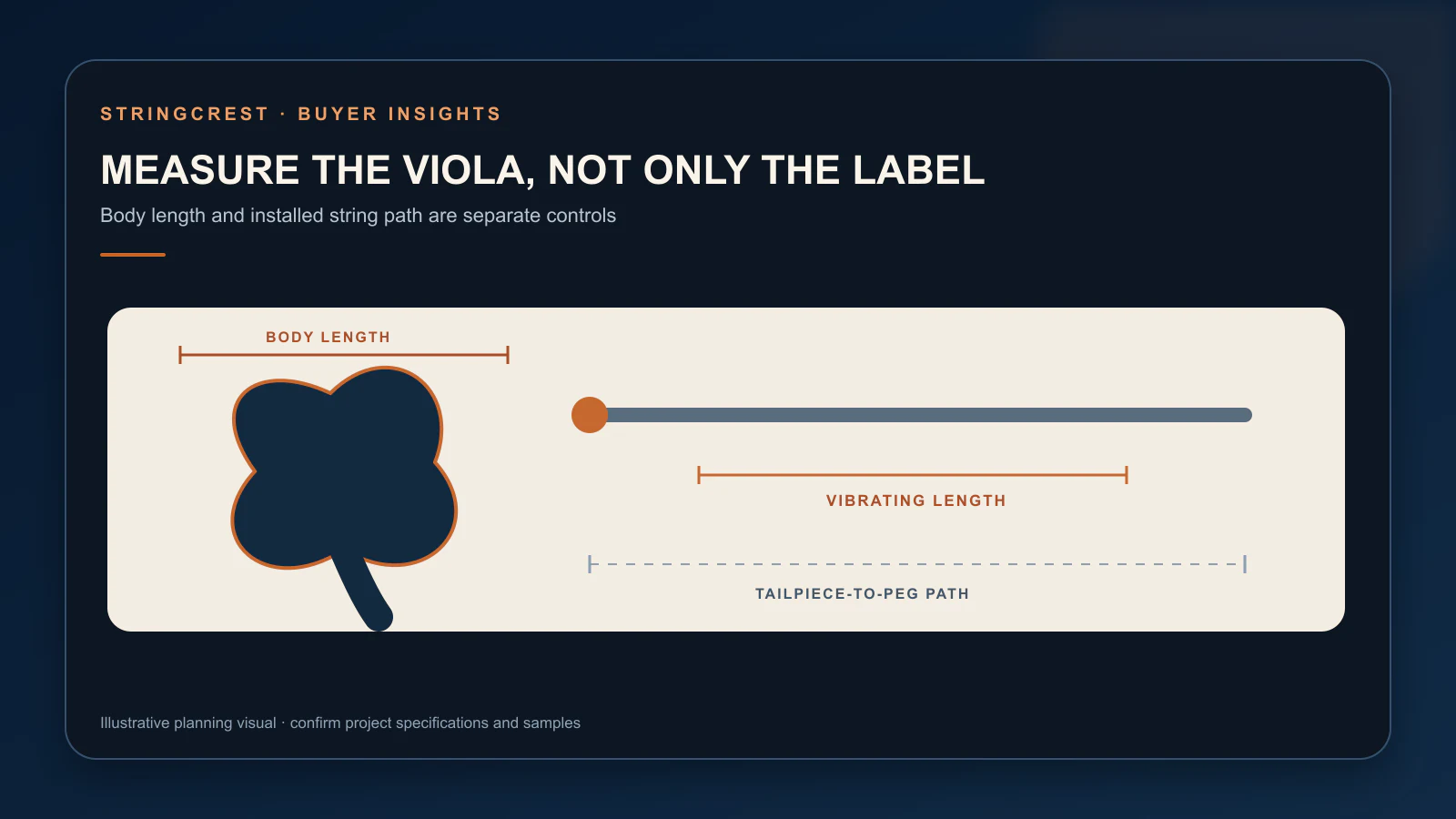
Viola sizing is less uniform than violin sizing. Buyers often refer to an instrument by its body length, while a string supplier may group products as extra-short, short, medium, long or extra-long scale. Those labels are not enough on their own. The request should state how the instrument was measured and provide the relevant body length, vibrating string length from nut to bridge, and complete string path from tailpiece to peg.
Official D’Addario orchestral guides illustrate why the measurement method belongs in the brief. One comparison chart maps viola size groups to body-length bands, while individual product families offer different combinations of short, medium, long and extra-long options. This is useful industry evidence that size families exist; it is not a cross-brand conversion standard. A buyer should never assume that one maker’s “medium” equals another supplier’s “medium” without checking the declared dimensions.
For a school or rental program, list the actual instrument sizes in the fleet and the quantities by group. For a retail range, identify the common sizes among target customers and keep uncommon sizes as special-order candidates until demand is proven. For a private-label launch, a narrow, clearly described range is safer than one package that claims compatibility with every viola.
| Measurement | Record in the buyer brief | Reason |
|---|---|---|
| Instrument body length | Inches and millimeters, with measurement method | Prevents ambiguous size labels |
| Vibrating length | Nut to bridge | Affects tension and playing response |
| Tailpiece-to-nut path | Actual installed path | Confirms usable string and winding length |
| Pegbox path | Nut to each peg | Helps check silk and winding transitions |
| Reference setup | Bridge, tailpiece and fine-tuner notes | Captures fit conditions used for approval |
Specify all four positions as one system
A set is more than four independent catalog lines
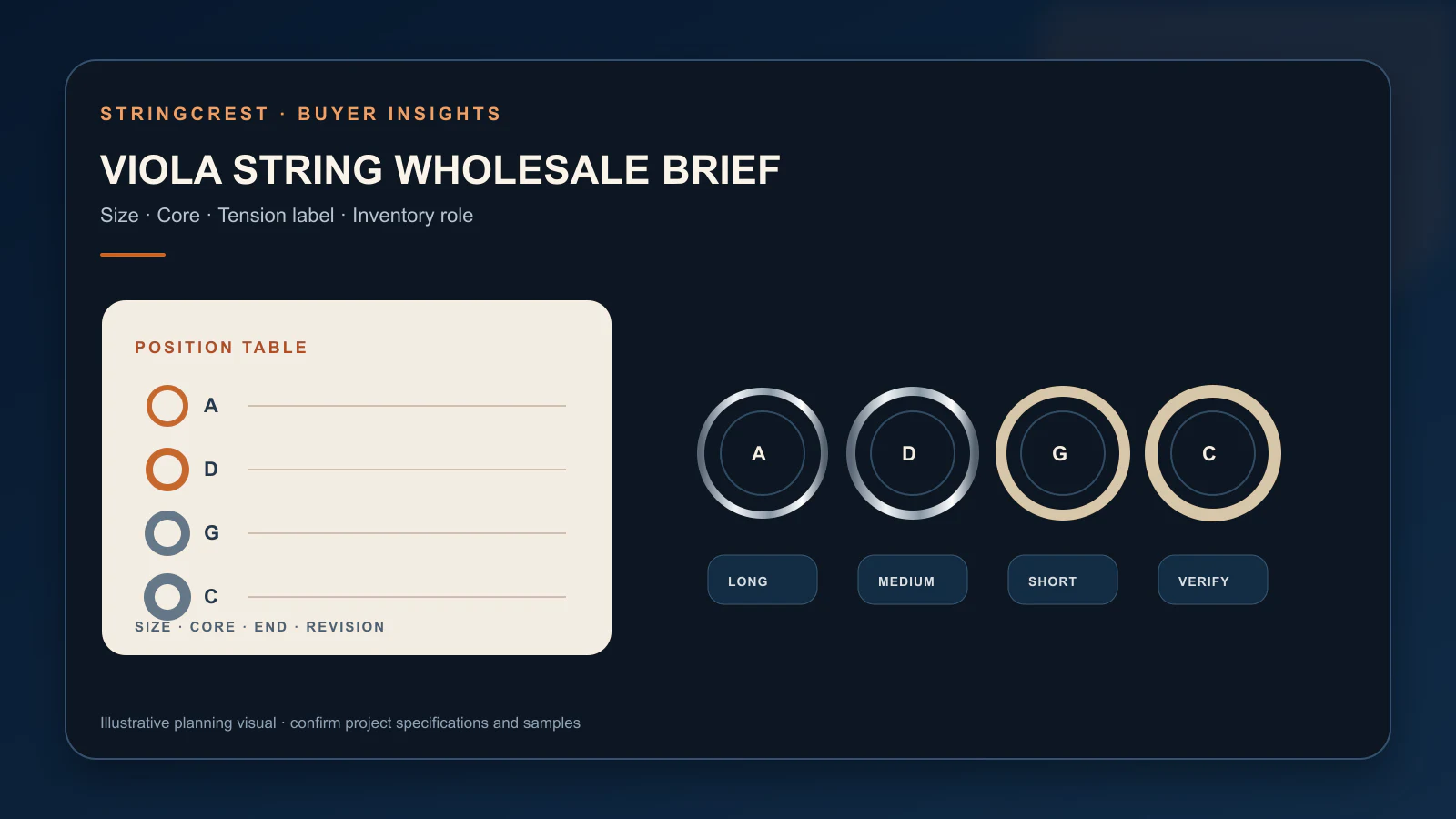
A standard viola set contains C, G, D and A positions, but each position can use a different combination of core, winding material and surface finish. The A string may behave very differently from the lower three, and a buyer may deliberately mix families. The specification sheet should therefore list every position separately even when the commercial product is sold as one set.
Record nominal construction, declared core family, winding material, end construction, size group and tension label for each position. If the supplier provides nominal diameter or unit-weight information, keep it in the controlled technical record. Do not publish a measurement that has not been confirmed for the approved revision. Likewise, do not infer the inner core from the color of the winding or silk.
Official orchestral references commonly distinguish solid steel, stranded steel and synthetic cores. These categories describe construction, not guaranteed sound. A solid steel core uses a single central wire. A stranded steel core uses multiple steel filaments in a cable-like structure. A synthetic core uses man-made multifilament material. Gut is another historical core family, but a buyer should include it only when it is actually within the project scope and documentation. Each family can be combined with different winding choices, so a core label is not a complete product definition.
The practical B2B question is whether the four positions feel and respond as a coherent set on the reference instruments. A string that performs acceptably by itself can still create an undesirable transition from the adjacent position. Sample evaluation should therefore include cross-string bow response, volume relationship, left-hand feel and tuning stabilization across the complete set. These are observations on the tested instruments, not universal performance claims.
Treat tension labels as family-specific information
Light, medium and heavy are not universal numbers
Tension labels help buyers compare options within a defined product family. They should not be treated as fixed values that transfer between materials, scales or suppliers. Actual tension depends on string unit weight, vibrating length and pitch. A longer vibrating length or a change in construction can alter the result even when the package uses the same broad word.
The buyer’s first control is the reference tuning and scale. Standard viola tuning should be written position by position rather than assumed, especially if any alternative tuning is being considered. The second control is a supplier tension sheet or other declared technical basis. The third is a sample test on the instruments that matter to the project.
When comparing two sample sets, hold the instrument and setup constant. Record whether the sample requires unusual peg, nut, bridge or fine-tuner adjustment. Do not create a marketing claim such as “more power” or “easier response” from a single player comment. Instead, summarize repeated observations and state the evaluation conditions. If the buyer needs a tension claim on packaging, define the comparison basis and keep the evidence with the approved artwork.
Confirm end construction and installed fit
Tailpiece and pegbox details can decide whether a string is usable
Many modern viola strings use ball ends, yet the buyer should still state the required end construction and check the target tailpiece or fine-tuner arrangement. The ball must seat correctly without binding or passing through an opening that is too large. Any removable-ball or alternative-end requirement must be explicit; it should not be assumed from a market photograph.
At the pegbox end, the buyer needs enough usable length for safe installation while keeping thick winding or silk transitions in appropriate locations. A string that is too short may not provide enough wraps. A string that is too long may place an undesirable transition on the nut or peg. These checks become more important when one size label is expected to cover several instruments.
Inspect the installed path rather than only the loose string. Photograph the tailpiece seating, bridge and nut path, and peg wraps for each reference size. Record whether the string was installed with or without a fine tuner and whether any adjustment was required. A pass should mean that the sample fits the declared setup as supplied. It should not depend on unapproved modification of the instrument.
Build a controlled sample plan
Compare purposeful variants, not unidentified bags
Every sample set should have a code that links to a revision-controlled specification. The code should identify size group, tension category, core and winding family, end type, and revision date. If the sample contains a mixed A string, record that difference rather than describing the whole set with one material word.
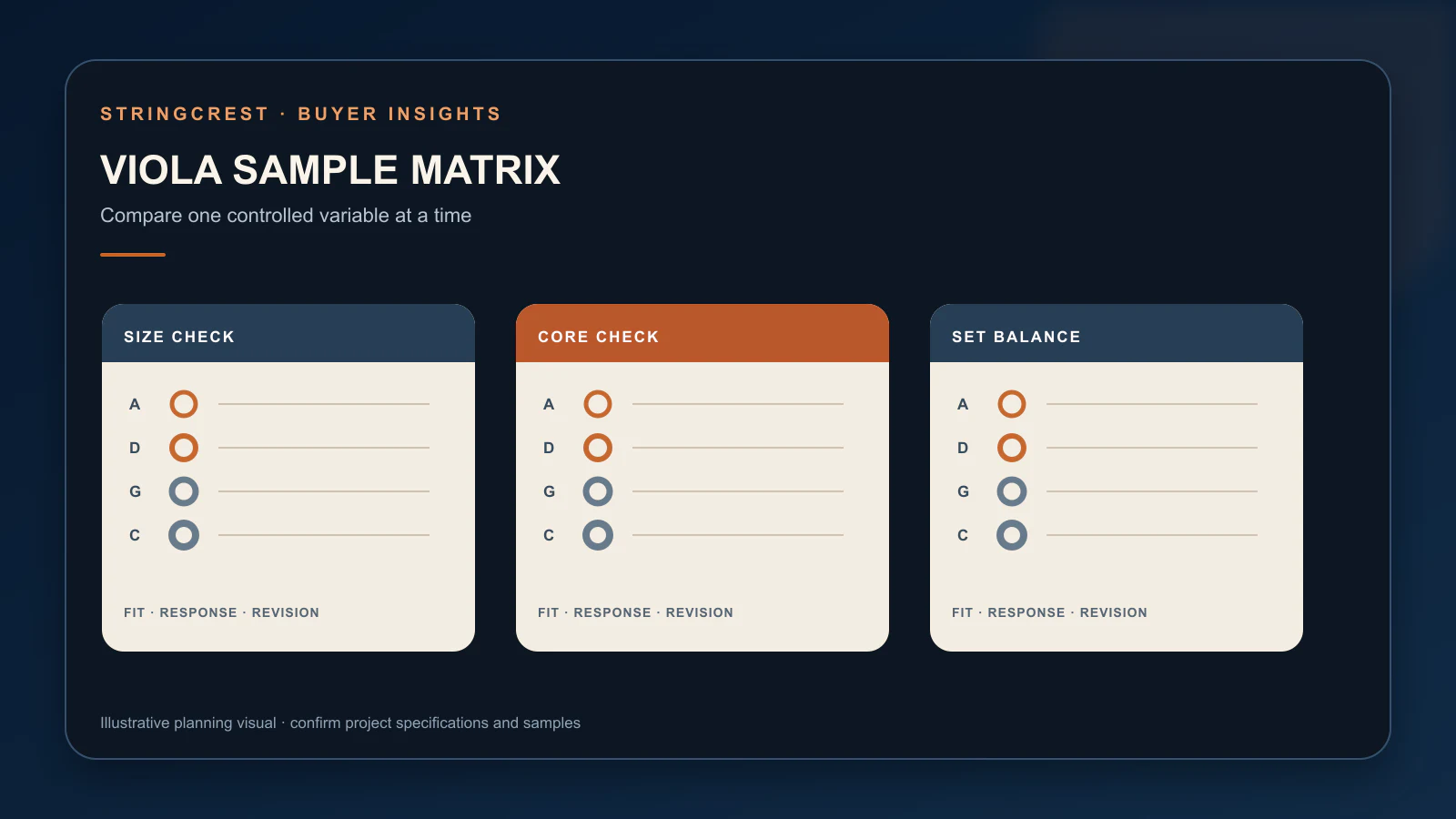
Choose reference instruments that represent the intended range. A school-supply project may need multiple body lengths. A specialist retail project may need fewer sizes but more construction alternatives. The sample plan should change one major variable at a time. For example, compare core family while holding size and declared tension constant, or compare size fit within the same construction family. Changing core, tension and winding at once makes the feedback difficult to interpret.
Use a structured form for receiving and installation. Confirm that the package code matches the technical sheet. Inspect the winding surface and end attachments. Install on the correct reference instrument, bring the strings to pitch using normal procedures, and record fit before making tonal judgments. After an agreed stabilization period, record tuning behavior, bow response, balance across strings and any visible movement at the ends or windings.
The evaluation record does not need to imitate a laboratory report. It needs to show which sample was tested, on which instrument, under which setup, by whom and on what date. If a result is subjective, label it as an evaluator observation. If a dimension is measured, record the tool and units. If a defect appears, preserve the sample code and photographs so the supplier can investigate the correct revision.
| Gate | Review question | Retained evidence |
|---|---|---|
| Receiving | Does the sample code match the requested revision? | Label photo and receiving log |
| Construction | Are four positions and materials identified? | Technical sheet and inspection notes |
| Fit | Do ends, winding transitions and peg lengths suit the declared size? | Installed photos and measurements |
| Playing review | Is the set coherent on the reference instrument? | Structured evaluator form |
| Approval | Can production and packaging be tied to the same revision? | Signed approval and artwork record |
Plan sets and singles as separate inventory decisions
Replacement demand does not always match set demand
Wholesale customers may buy complete sets, individual positions, or both. A school fleet may need a predictable supply of commonly replaced A strings. A specialist shop may carry complete sets plus selected singles for mix-and-match customers. A private-label brand may begin with sets because singles multiply packaging, barcode and forecasting work. None of these approaches is automatically correct.
Build the assortment from observed channel needs. For every proposed SKU, define the instrument size, position or set, construction family, tension category, pack format and target customer. Then check for near-duplicates. Two packages with slightly different names but the same practical role can split inventory without improving the customer decision.
Singles require special identity control. The package should make the position, instrument, size, tension label and material clear. Color coding can assist recognition, but color must not replace readable text and a stable SKU. If multiple generations use similar silk colors or envelopes, warehouse staff need another reliable identifier.
Set and single compatibility also needs care. A replacement single should match the intended set revision or be described as an alternative, not silently substituted. If the buyer approves a revised A string, the change-control record should identify which set SKUs receive it and from which production batch or order.
Keep packaging claims within the evidence
Clear identification is more valuable than vague prestige language
The front of a viola-string pack should help the buyer identify the instrument, size, position or set, core or material family where relevant, tension category and brand. The back or technical panel can add installation, storage and traceability information. Claims about tone, stability, durability or climate behavior require an evidence basis and careful wording.
Do not copy another brand’s size chart into private-label artwork. Use the approved project dimensions and terminology. If the range uses short, medium and long labels, explain the measurement basis or provide a clear compatibility chart. Where instruments vary, use language such as “confirm instrument body length and string scale” rather than a universal-fit promise.
Artwork control should include revision number, barcode, pack count, country-specific legal text, and a link or contact path for technical questions. Inner protection, envelopes and outer cartons should be confirmed separately from string performance. Packaging material claims and corrosion-protection claims must match the actual approved format and evidence; an article cannot verify them.
Prepare a quotation sheet suppliers can answer consistently
Separate the technical brief from current commercial terms
A useful RFQ includes the target market, instrument sizes, complete set or single positions, tuning, core and winding direction, end construction, tension category, packaging format, artwork status, sample quantity and forecast structure. Open fields should be marked as requests for supplier recommendation. Fixed fields should be identified as requirements.
Ask suppliers to show deviations clearly. If a proposed size group uses a different body-length range, the quotation should state it. If one position uses a different core or end construction, that difference should appear in the position table. MOQ, price, sample charges and lead time must come from the current quotation because they depend on the final configuration and order conditions.
Before volume approval, reconcile the technical sheet, identified physical sample, packaging proof and purchase order. They should share a revision reference. If the artwork says “medium scale” but the sample sheet says “long scale,” stop the approval. This document check is less expensive than correcting labels after packing.
Common viola-string sourcing mistakes
The first mistake is treating body length and string scale as the same measurement without stating the method. The second is assuming that “medium tension” is a universal numeric specification. The third is describing an entire set with one material word even when positions differ. The fourth is approving tone before checking basic end and winding fit.
Another mistake is launching too many size and single-string SKUs without channel evidence. Complexity affects artwork, barcodes, forecasts and replacement matching. Finally, do not convert one supplier’s size chart or marketing language into a private-label claim. Competitor pages can reveal which variables buyers encounter; the approved product still needs its own specifications and samples.
FAQ
What size information should a viola-string buyer provide?
Provide the instrument body length, vibrating string length, complete tailpiece-to-peg path and the measurement method. Add the tailpiece, fine-tuner and pegbox details used for sample approval. Do not rely only on short, medium or long labels.
Are all medium-tension viola strings equivalent?
No. Tension labels are meaningful within a defined construction and product family. Materials, unit weight, vibrating length and pitch affect actual tension and response. Compare declared data and identified samples on the same reference instrument.
Should a wholesale range include singles as well as sets?
That depends on replacement demand, channel type and inventory capacity. Retailers and school programs may value selected singles, while a new private-label range may begin with fewer complete-set SKUs. Use sales and service evidence rather than assuming every position needs a separate pack.
Can one viola string size fit several body lengths?
A supplier may define a size range that covers several instruments, but the buyer should verify installed length, winding transitions, end seating and response on each declared reference size. Packaging should state only the compatibility that was actually approved.
What should be approved before placing a bulk order?
Approve the position-by-position specification, size definitions, identified samples, packaging artwork, pack configuration and purchase-order revision. Confirm current MOQ, price and lead time directly in the quotation.
Conclusion
A reliable viola-string wholesale brief starts with measured instruments and a position-by-position construction table. Size labels, tension words and core categories become useful only when their definitions are attached to a specific revision. Controlled samples then show whether the four strings fit and work together on the target instruments.
For B2B buyers, the strongest range is not necessarily the one with the most SKUs. It is the range in which every set and single has a clear role, accurate size language, traceable approval and a packaging identity that warehouse staff, retailers and players can understand.
Explore folk and orchestral string options · Send your viola string requirements
Sources and interpretation limits
- D’Addario orchestral string comparison chart
- D’Addario Pro-Arté viola string set, short scale
- D’Addario Helicore viola string set, short scale
These official sources document one manufacturer’s size groups, core categories and product examples. They do not establish StringCrest specifications, availability, test results or commercial terms. Confirm all project dimensions, samples and quotations before publication or ordering.
FROM GUIDE TO PRODUCT
Connect this guide to Folk & Orchestral Strings.
Review the relevant range, then bring the instrument, complete specification and open questions into one project brief.
YOUR PRODUCT · YOUR BRAND
Discuss your next string project with Frank.
Share your instrument category, target market, gauge or material direction and private-label packaging requirements.

ABOUT THE AUTHOR
Frank Zou
Frank works directly with musical-instrument brands, importers and distributors on string specifications, product selection and private-label project requirements.
Meet Frank