
Product Selection
Product Selection
Cello Strings Wholesale: A Size, Core and Four-Position Specification Guide
Build a cello RFQ around instrument size, A–D–G–C positions, core family, tension, fit, samples and receiving checks.
Introduction
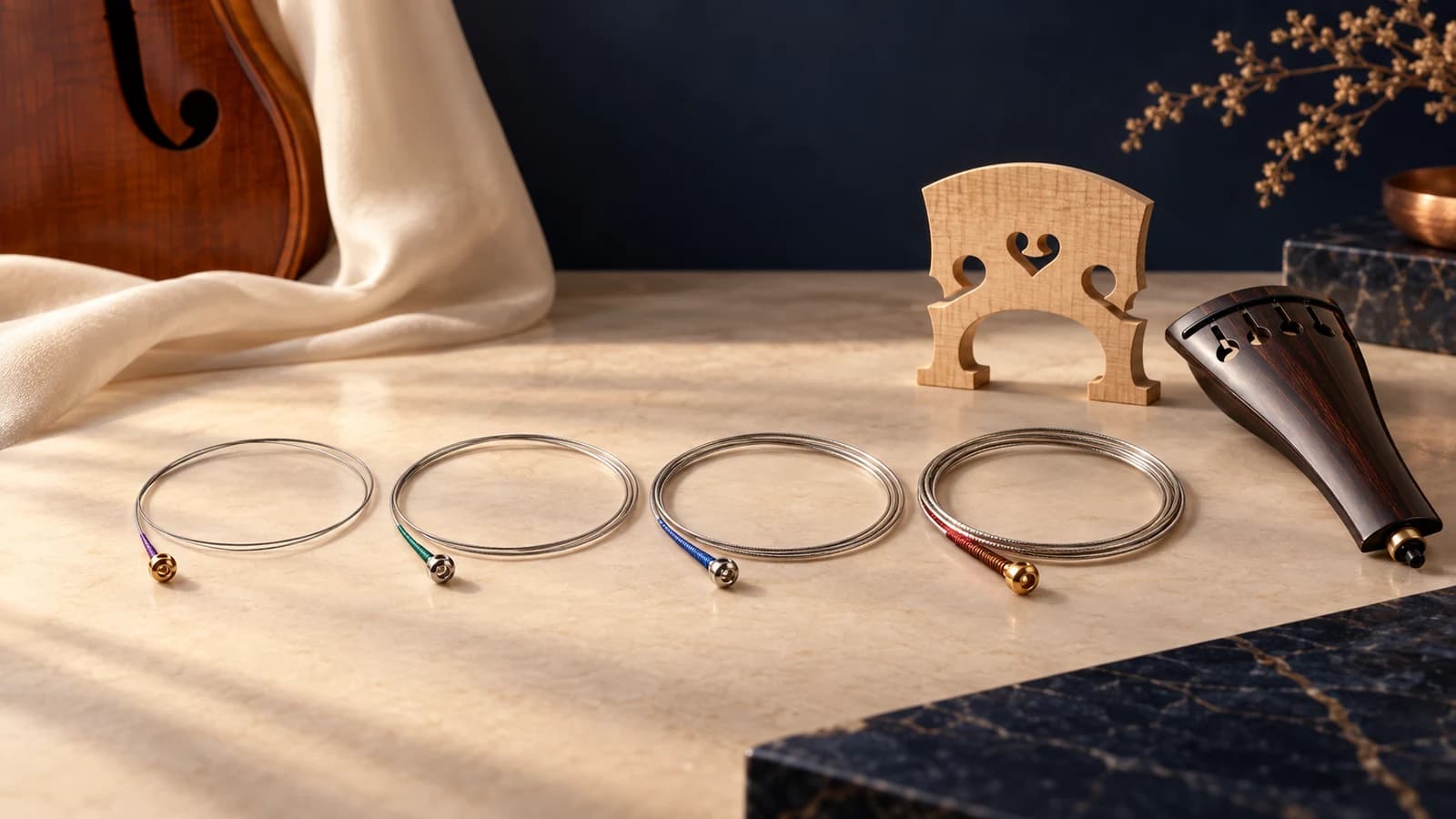
A cello-string proposal needs a four-position construction map and an instrument-specific length record. For the standard four-string reference used here, positions 1–4 run from highest to lowest: A3, D3, G2 and C2. Record the core, winding, end and identity of each component separately. A family name does not establish that all four strings use the same construction, and a fractional instrument-size label does not supply a measured speaking length.
For a U.S. brand, importer, distributor or music store, the buying decision is whether a named four-component proposal matches the intended cello and the scope of the sample review. The blank records below help define that proposal. They are not approved StringCrest specifications, available SKUs or completed installation results.
Build a four-position construction map
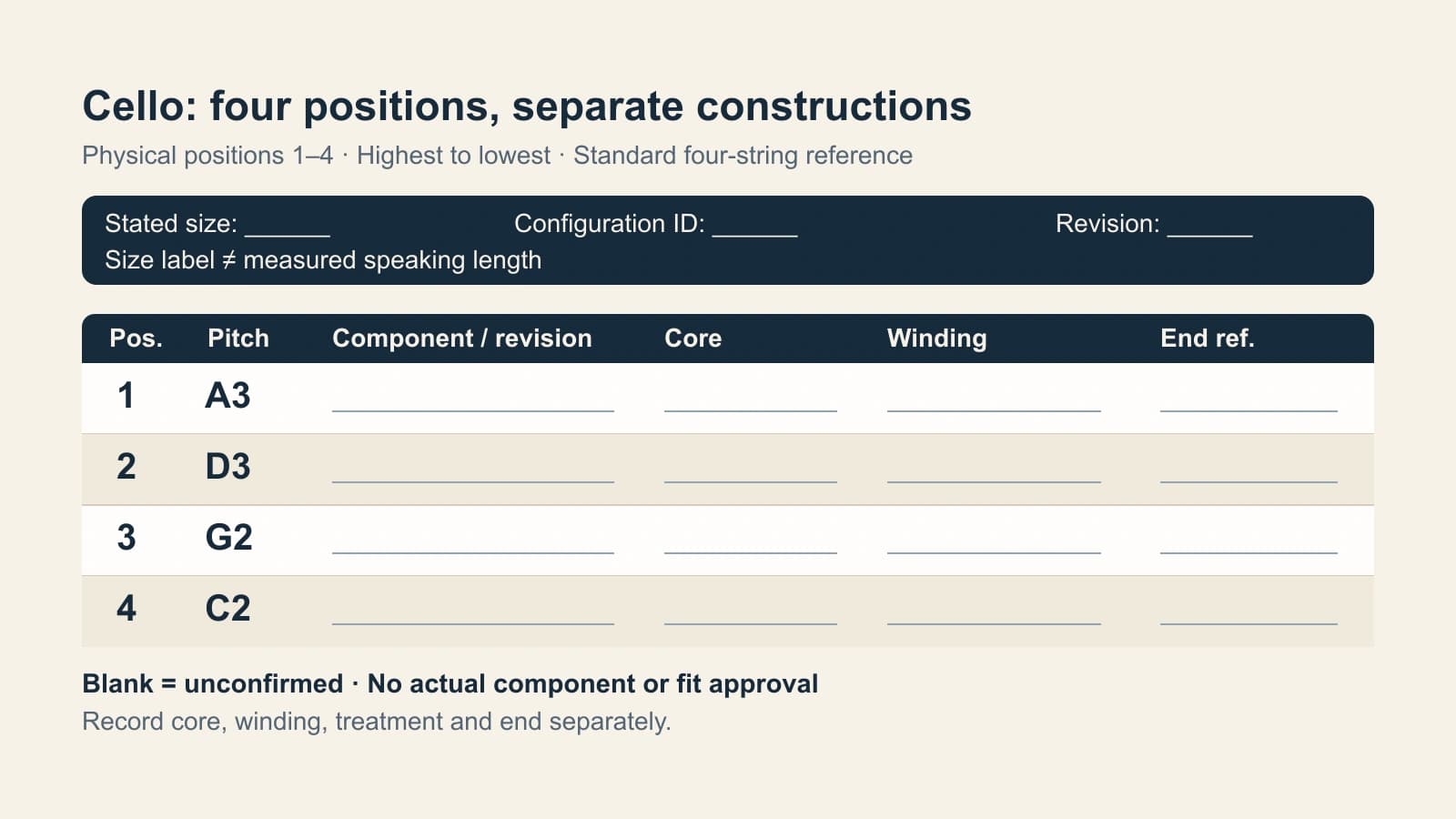
Define the numbering before exchanging a set sheet. This guide uses position 1 for the highest open string and position 4 for the lowest. Yamaha's cello overview gives the A3, D3, G2 and C2 octave notes. Those notes identify the standard tuning reference; they do not specify a string's size or materials. A different intended tuning needs its own explicit map.
Use one construction sheet for each proposed size and set revision. Keep the instrument/configuration reference on the same sheet. The following fields are deliberately blank.
| Position | Open note | Component code / revision | Core construction | Winding materials | End / drawing reference |
|---|---|---|---|---|---|
| 1 | A3 | ______ | ______ | ______ | ______ |
| 2 | D3 | ______ | ______ | ______ | ______ |
| 3 | G2 | ______ | ______ | ______ | ______ |
| 4 | C2 | ______ | ______ | ______ | ______ |
A missing winding entry means unknown, not “plain” or “no winding.” Likewise, a core description does not establish its internal strand count, diameter or alloy unless the maker actually declares those details. Keep any coating or treatment separate from the core and winding fields. Add finished gauge, the maker's tension designation and the applicable length/transition reference to each component record when supplied; do not fill them by copying another brand's table.
Read a manufacturer's example by position
Pirastro's Evah Pirazzi cello, 4/4 Mittel options illustrate the distinction. Its description identifies single-filament steel cores with chrome-steel winding for A and D, and rope cores with tungsten winding for G and C. The corresponding 4/4 Mittel rows identify separate components and ball ends. See the official description and options.
That named family is a useful counterexample to treating one set label as four identical core/wrap declarations. It does not define the materials, end dimensions or tension of a StringCrest proposal. Nor does it establish that every cello family follows the same A/D versus G/C split. Use the actual component list for the proposed range.
Keep a label such as “medium” with its maker and selected variant. If a numerical tension value is used in a comparison, retain its unit, source, stated pitch and reference length. A tension label is not a measurement taken on the buyer's cello.
Keep the size label separate from measured length
Record the cello's stated body-size designation and its actual instrument ID first. Then obtain the relevant length measurements with their units and defined endpoints. Do not turn a label such as 3/4 into a length by multiplying a presumed full-size measurement by three quarters.
Manufacturers can publish size and length as separate information. For example, Thomastik-Infeld's Peter Infeld cello flyer labels the line 4/4 and states a 70.0 cm vibrating-string-length reference. That is the named line's published reference. It is not a measurement of an unidentified cello or a universal dimension for every instrument labelled 4/4.
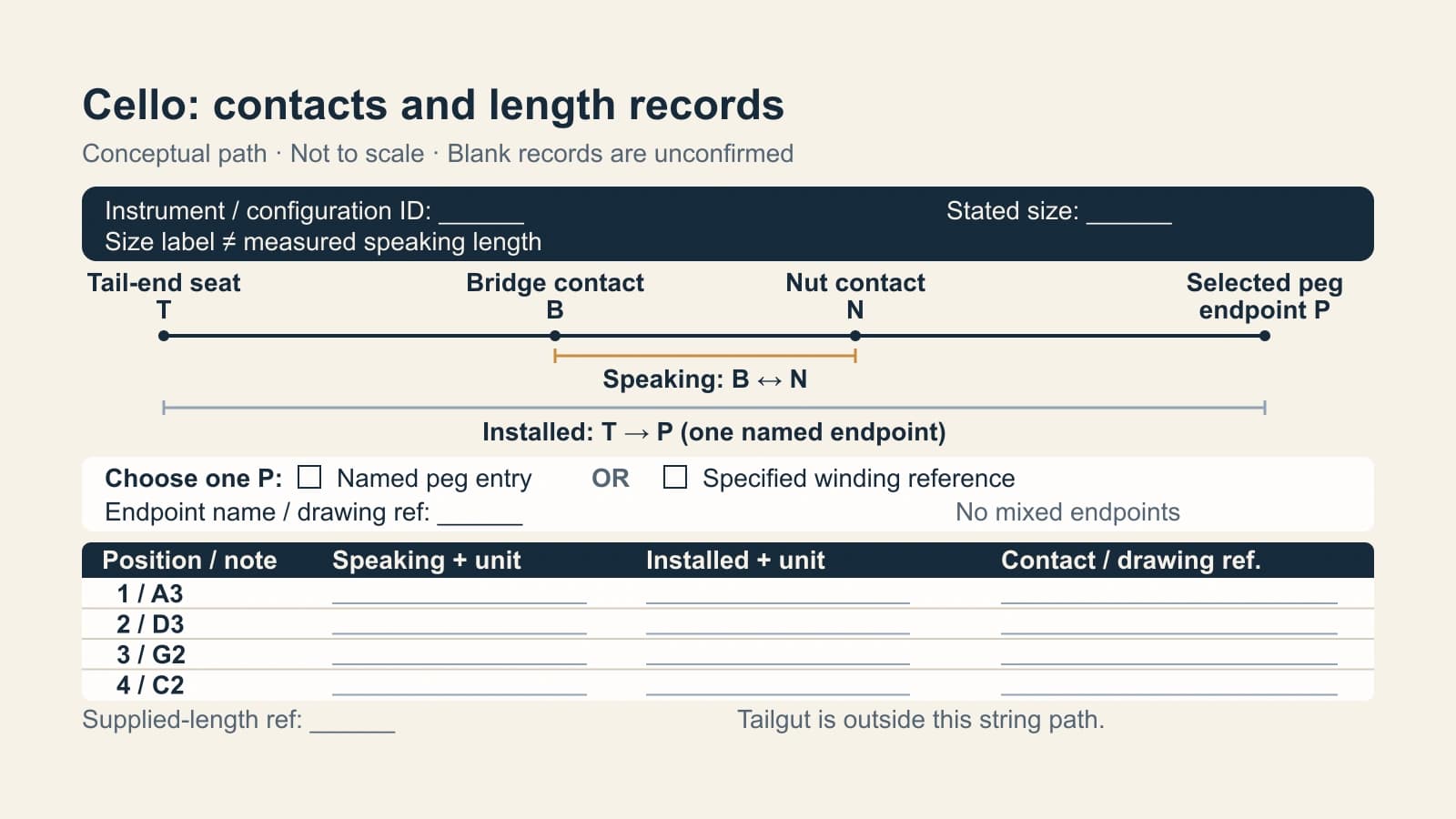
For this record, open-string speaking length means the string segment between its actual nut and bridge speaking contacts. Identify those contacts on the intended instrument, rather than measuring from convenient edges of the wooden parts. Record the method and setup state with the value. An existing photograph can help identify parts, but perspective alone does not provide a reliable physical measurement.
The string still needs a suitable route beyond that speaking segment. Its end must reach and seat at the actual tailpiece or fine tuner, while its upper section must follow the route through the nut to the peg. The supplied string length and usable construction zones need the maker's own definition. A speaking-length value alone cannot settle those requirements.
Trace the tailpiece, bridge, nut and peg route
Start with the actual hardware identities. Record the tailpiece assembly, any fine tuner and the intended string-end variant. Keep any tailpiece mounting or tailgut reference separate from the string's own path. A ball-end entry in a catalog is not an end-dimension drawing or proof that it seats correctly in the proposed hardware.
For each of the four positions, identify these references:
- Tail-end seating datum: the specified point where the string end bears in the intended attachment, plus the relevant hardware and instruction reference.
- Bridge and nut contacts: the actual speaking boundaries and any identified issue at those contacts.
- Peg route: the route beyond the nut, the peg entry/winding reference and the maker's applicable installation guidance.
- Construction transitions: the locations of full winding, silk, taper or other declared transitions, where present. Record them against the intended contacts and the maker's instructions; do not invent a universal allowed location or cutting allowance.
This is a documentation task, not a procedure for modifying an instrument or string. Ask the instrument maker or a qualified cello technician to identify an obscured contact or a check that requires intervention. Do not file a fitting, change a groove or alter an end to make an unspecified sample appear compatible.
Use the following per-position record alongside the construction map. Enter units with every measured length. Empty fields remain unresolved; none represents a measured zero or a passed check.
| Position / note | Speaking length + unit | Installed path + unit | Tail-end seat / hardware reference | Nut, peg and transition reference | Evidence / unresolved issue |
|---|---|---|---|---|---|
| 1 / A3 | ______ | ______ | ______ | ______ | ______ |
| 2 / D3 | ______ | ______ | ______ | ______ | ______ |
| 3 / G2 | ______ | ______ | ______ | ______ | ______ |
| 4 / C2 | ______ | ______ | ______ | ______ | ______ |
Define installed path here as the route from the named tail-end seating datum to a named peg-entry point or another explicitly specified winding reference. Select one endpoint and label it on the record; do not compare lengths taken to different endpoints. Keep it distinct from the speaking segment and from the supplier's overall supplied-length measurement. Identify the datum and route on a reference drawing or record; do not infer a finished cutting length from this blank table.
To discuss a candidate, describe the cello's stated size, four-position proposal and available length or hardware references. Include units and reference identifiers in the requirements message, and state which details are still unknown.
Keep a sample decision tied to its exact configuration
A set may intentionally combine different core constructions or component families. That choice needs an identifiable four-component list and a stated review scope. Shared family names do not replace the list, and different names do not by themselves prove a mismatch. Confirm the proposed combination with the responsible supplier/product reviewer and the intended instrument conditions.
For example, if a buyer proposes changing only the A string, identify the retained D, G and C components as well. State whether the review is checking the replacement A's documented identity, its physical installation, or the named four-component configuration. An approval covering one of those questions should not silently expand to the others or to another instrument size.
Use a short cover record for each actual sample configuration. These are blank inputs, not an account of a StringCrest sample trial.
| Configuration record | Actual entry |
|---|---|
| Configuration ID / revision and all four component references | ______ |
| Instrument ID / stated size and contact/path record revision | ______ |
| Intended octave tuning and setup state | ______ |
| Maker instructions and supplied/usable-length references | ______ |
| Documentary check: what is identified, missing or inconsistent | ______ |
| Physical installation, if performed: installer / date / method reference | ______ |
| Observations by position and unresolved issues | ______ |
| Decision, conditions, reviewer identity / role / date | ______ |
Keep documentary identification separate from physical fit. A complete catalog or drawing record can identify a proposed combination without showing that anyone has installed it. Mark an unperformed installation as untested, not passed. An unknown construction or contact remains a missing input; a documented mismatch blocks that proposed use until it is resolved. Neither state is evidence that the string is defective in every application.
When an actual review is carried out, record the observed position and conditions before assigning a cause to buzzing, slipping, damage or tuning behavior. Retain the reviewed component identities and document any later change. Broader sample identity and approval controls are covered in the guitar-string sample-evaluation guide; adapt that workflow with the cello-specific size, contacts and paths recorded here. The linked guide does not establish cello test results.
FAQ
Can a 4/4 string be made suitable for a smaller cello simply by cutting it shorter?
Trimming alone does not establish a suitable construction, tension reference, end fit or transition placement. Obtain the maker's recommendation for the actual instrument and intended tuning, including usable-length and installation requirements. This guide supplies no universal cut length or permission to modify an end.
Does approving one replacement string approve the complete mixed set?
Only the recorded scope is approved. A component's documentary match, a physical fit check and a review of the four-component configuration answer different questions. Keep the other three component identities, instrument, size and conditions explicit. A change outside that scope needs its own review decision.
Conclusion
Prepare the cello proposal around four identified components, the intended instrument and separately defined speaking, installed and supplied lengths. Keep missing material or contact information visible in the working record, then limit any sample decision to what was actually reviewed.
Explore the Folk & Orchestral family, or describe your proposed cello configuration and remaining fit questions. Actual StringCrest specifications, sample options and commercial terms require confirmation for the project.
FROM GUIDE TO PRODUCT
Connect this guide to Folk & Orchestral Strings.
Review the relevant range, then bring the instrument, complete specification and open questions into one project brief.
YOUR PRODUCT · YOUR BRAND
Discuss your next string project with Frank.
Share your instrument category, target market, gauge or material direction and private-label packaging requirements.

ABOUT THE AUTHOR
Frank Zou
Frank works directly with musical-instrument brands, importers and distributors on string specifications, product selection and private-label project requirements.
Meet Frank