
Product Selection
Folk & Orchestral
Double Bass Strings Wholesale: A Size, Tuning and Playing-Style Specification Guide
A B2B guide to double-bass size and scale, position construction, arco and pizzicato sample tasks, installed fit, sets, singles and packaging.
Introduction
Buying double bass strings wholesale involves more variables than selecting a “3/4 medium” set. Double bass instruments vary in playing length, bridge and tailpiece geometry, extension systems, string count and setup. String families also use size and tension labels within their own product systems. A buyer therefore needs to define the reference instruments, tuning, four or five positions, scale path, core and winding construction, end fit, playing-style priorities, sample method and inventory plan before requesting comparable quotations.
The largest sourcing risk is to treat an instrument-size fraction as a complete dimensional specification. A 3/4 label is common in the market, but it does not replace measured vibrating length and total installed path. Another risk is to translate broad product-family terms such as orchestral, pizzicato or hybrid into guaranteed performance. Those labels can guide sample selection; they cannot prove that a proposed private-label set will work for every player or bass.
This guide is for orchestral distributors, education suppliers, bass specialists and private-label brands. It explains how to structure a double-bass RFQ, evaluate arco and pizzicato requirements, plan standard sets and replacement singles, and control packaging claims. It does not present a StringCrest product specification, confirmed availability, MOQ, lead time, customer case or test result. Final data must come from a current proposal and approved physical samples.
Define instrument size with measured dimensions
Trade size and string scale are related but not interchangeable
Official D’Addario orchestral charts list multiple double-bass string sizes across product families, including fractional options and 3/4 examples. The chart demonstrates that size ranges exist and differ by family. It does not establish a universal dimension for every supplier. A buyer should record the exact measurement method used by the project.
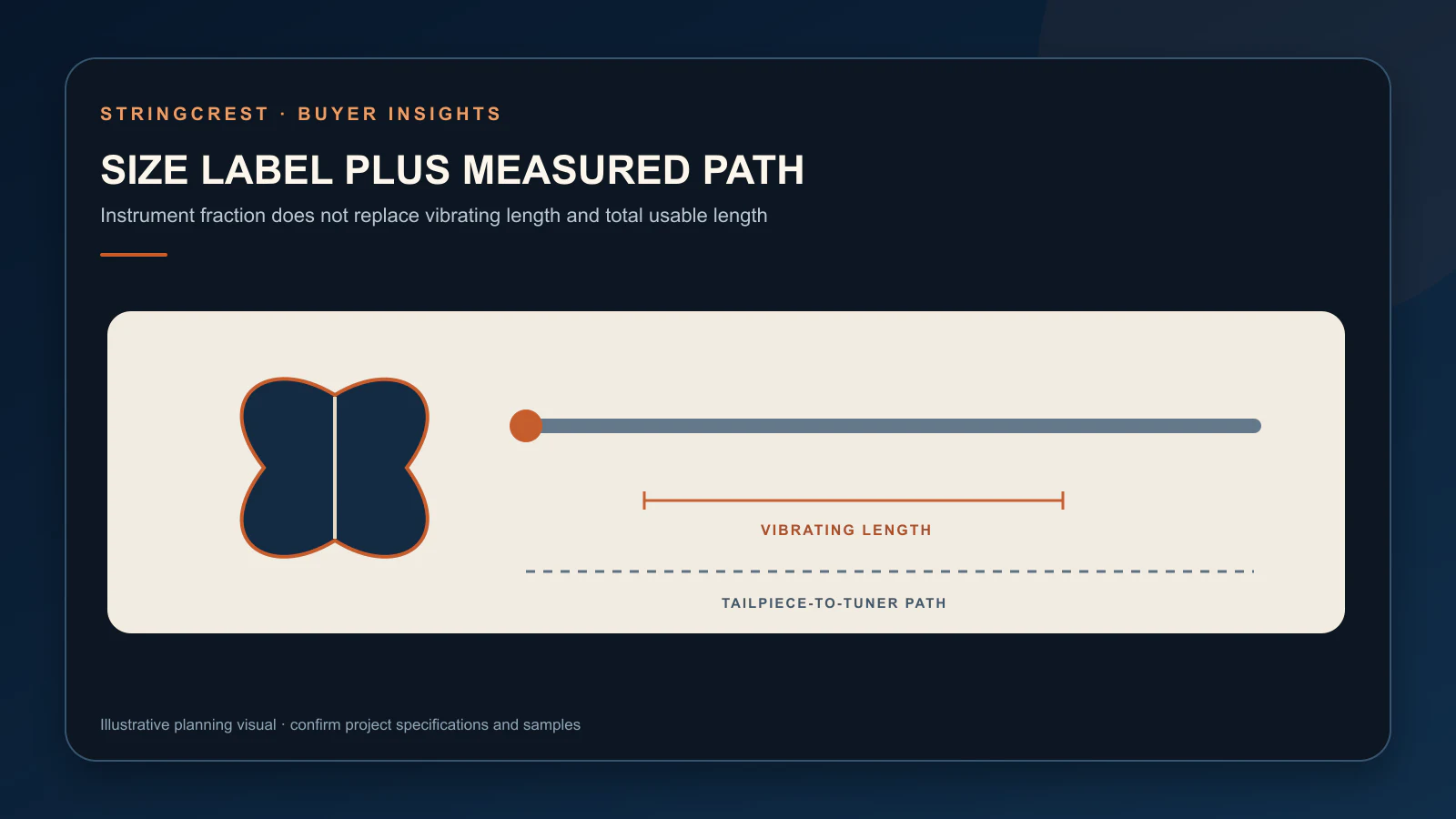
Measure the vibrating length from nut to bridge. Then record the complete path from the tailpiece or ball seat to the nut and from the nut to each tuner. Note bridge height and tailpiece arrangement where they affect installation. For an education fleet, list the actual fractional sizes and quantities. For a retail line, identify which size groups are core stock and which can remain special order.
The supplier should state the intended instrument-size label, the corresponding dimensional range and the usable string length. If one set is proposed for more than one instrument size, verify it on each declared reference bass. A string can reach pitch while still putting silk, taper or winding transitions in an unsuitable location.
| Instrument record | Minimum detail | Procurement reason |
|---|---|---|
| Trade size | Fractional or full-size label used by the channel | Supports retail identification |
| Vibrating length | Nut to bridge in millimeters and inches | Defines the speaking scale |
| Tailpiece path | Ball seat or anchor to bridge and nut | Confirms installed winding length |
| Pegbox path | Nut to each tuner | Confirms total length and transitions |
| Setup notes | Bridge, tailpiece, extension and tuner details | Captures reference conditions |
Specify tuning and every string position
Standard sets, extensions and extra strings need separate maps
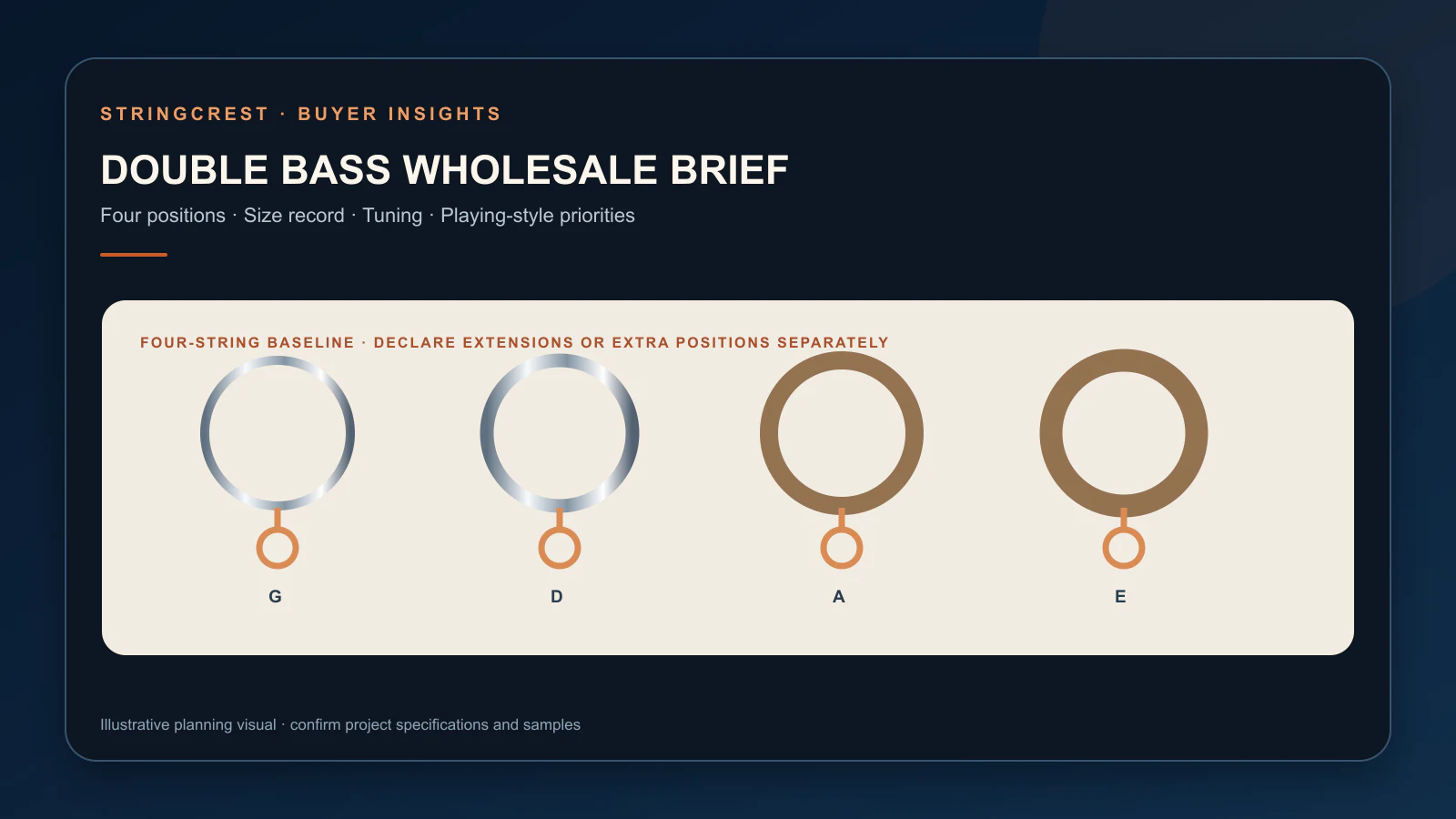
A conventional four-string double bass set is commonly organized as G, D, A and E. The RFQ should still write every note and octave convention used by the project rather than assuming the supplier’s naming system. If the project includes a low extension, added low string, solo tuning or another tuning system, specify it as a separate configuration.
List core material, winding material, nominal diameter or supplier gauge reference, tension category, end construction, usable length and revision for each position. Do not describe the entire set with one material word if positions differ. If the supplier provides tension data, retain the pitch, scale and method. A single total-tension number is less useful than position-level data tied to the reference scale.
Extensions and five-string basses require additional fit checks. Define whether the extra position is low or high, the target note, bridge and nut path, tuner location and intended extension mechanism. A single replacement string should be linked to the set revision so the construction and tension direction remain coherent.
Treat core and winding as a complete construction
Material categories describe structure before they describe sound
Official orchestral references distinguish stranded-steel, solid-steel, synthetic and gut core categories. One official double-bass example identifies a multi-stranded steel core and ball-end construction. These sources show the types of information a buyer may encounter; they do not establish StringCrest construction.
A stranded steel core consists of multiple steel filaments arranged into a flexible central structure. A solid steel core uses one main wire. Synthetic and gut systems have different material architecture. Each core can be combined with different winding and damping choices. The supplier should describe the actual proposed layers and position differences.
Avoid using core category as a guaranteed tonal result. Instrument setup, scale, player technique and winding design also influence the response. The buyer’s task is to select purposeful samples and evaluate them on reference basses. Material descriptions on packaging must match the approved technical sheet and supplier documentation.
Translate playing style into sample requirements
Arco, pizzicato and hybrid labels need defined evaluation tasks
Official product families use orchestral, pizzicato and hybrid language. One D’Addario orchestral example states that damping is optimized for arco use, while a hybrid example describes a balance between pizzicato sustain and bow response. These are brand-specific product descriptions. A private-label buyer should use them only to understand which sample variables may matter, not to copy performance claims.
For an arco-focused project, define the reference bows, typical passages and evaluator questions. Record response at soft and strong dynamics, position balance, unwanted surface noise and tuning behavior after installation. For a pizzicato-focused project, define attack, sustain and balance observations without turning them into unsupported numerical claims. A mixed-use range should be evaluated in both tasks.
Use at least two qualified evaluators where possible and identify the instruments. Player observations are subjective, so preserve the context. A comment such as “faster response” is useful only when the sample, instrument, bow, setup and comparison set are known. Do not promise universal jazz, orchestral, bluegrass or educational suitability from one evaluation.
The buyer may choose one general-purpose set and one more specialized set, but each SKU needs a distinct role. If evaluators cannot explain a meaningful difference, the two products may create inventory complexity without improving customer choice.
Review tension within a defined family
Light, medium and heavy are not cross-brand standards
Tension depends on unit weight, vibrating length and tuned frequency. A family’s light, medium and heavy labels help compare options inside that family. They should not be assumed equivalent across suppliers or core systems. Request position-level data where available and verify the declared scale.
Sample evaluation should hold the instrument and setup constant. Record whether a proposed set changes bridge behavior, neck relief, action or player comfort enough to require adjustment. Double bass setup is specialized; the article should not instruct buyers to make structural changes without a qualified technician.
If packaging uses a tension label, define which approved construction and size it describes. If the range contains multiple sizes, do not assume the same word represents the same installed force across all scales. Use supplier declarations and samples rather than generalizing from another brand’s chart.
Confirm tailpiece, bridge, nut and tuner fit
Long strings need a complete installation record
At the tailpiece, confirm the end construction and seating. An official product example uses ball ends, but buyers must state the required system for their project. The attachment should seat securely without binding or passing through the intended anchor. Inspect any protective silk or transition near the tailpiece and bridge.
The speaking section should cross the bridge and nut without a winding transition entering an unintended area. At the pegbox, confirm that the correct section reaches each tuner with enough length for normal installation. A string that is too long can place a thick transition around the post; a string that is too short can prevent safe winding.
Photograph each installed position and record the reference bass. For extension strings, document the complete additional path and mechanism. A pass should mean that the sample fits the declared setup without unapproved instrument modification.
Build a controlled sample and inspection plan
Receiving identity comes before playing preference
Assign every sample a code linked to size, tuning, construction, tension label, end type and revision. On receipt, confirm position labels, winding surfaces, end attachments and dimensions. Keep strings from different revisions separated. A loose unmarked set cannot support a reliable approval.
Install on the intended reference instruments and record the setup. Bring the set to pitch using normal professional procedures and note stabilization. Evaluate basic fit before tonal preference. If a defect appears, preserve the string, code, package and photos so the supplier can investigate the correct revision.
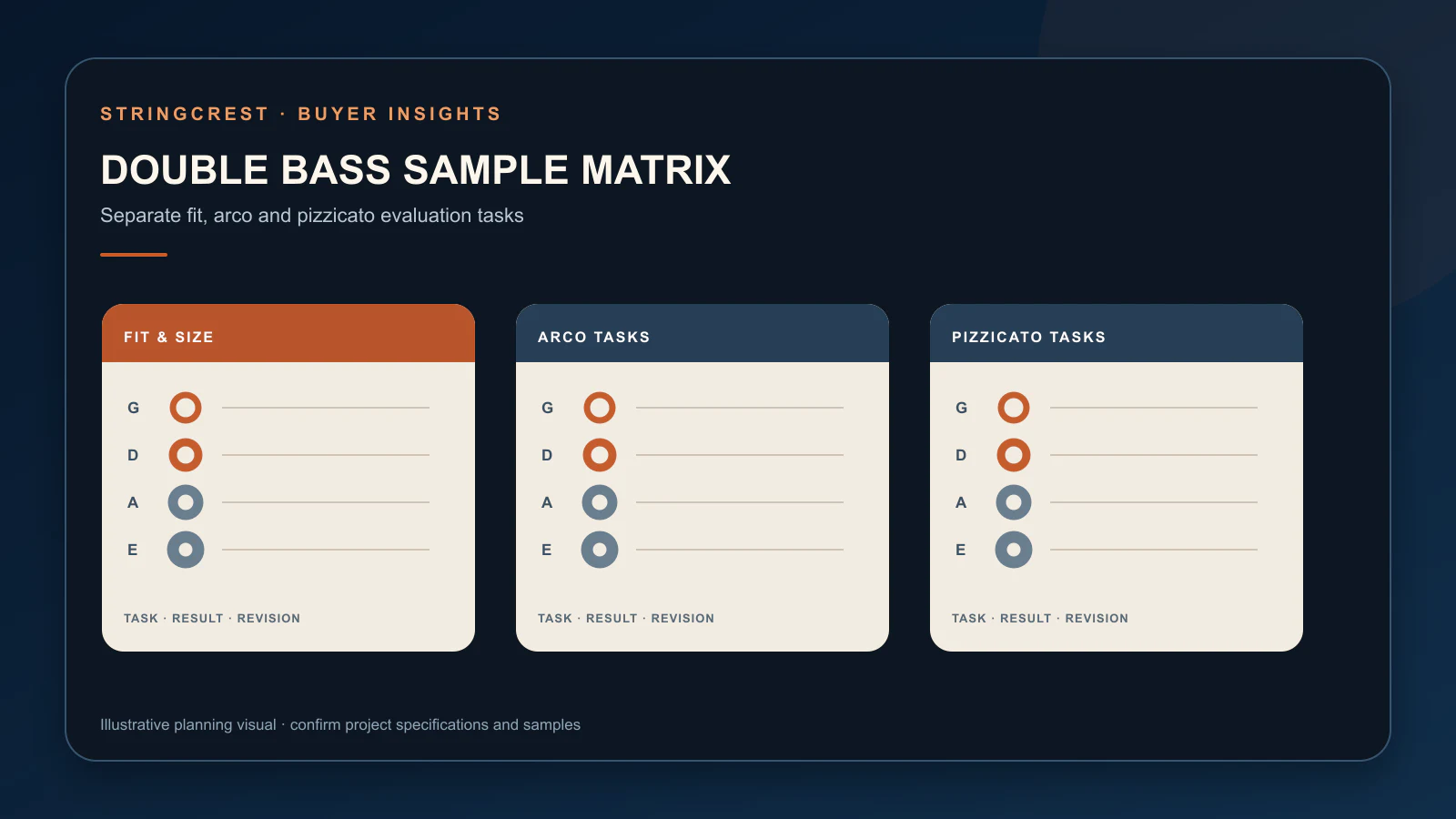
Use a matrix that separates objective records from player observations. Dimensions, count and visible construction can be checked directly. Bow response, sustain and feel should be labeled as evaluator observations. If the project includes education fleets, include practical installation and identification review by staff responsible for maintenance.
| Gate | Review question | Evidence retained |
|---|---|---|
| Receiving | Do all positions and codes match the requested revision? | Label photo and receiving log |
| Dimensions | Do speaking length, transitions and total length fit? | Measurement sheet |
| Installation | Do end, bridge, nut and tuner paths work? | Installed photos by position |
| Playing | Does the set meet the declared arco or pizzicato brief? | Structured evaluator records |
| Approval | Are sample, technical sheet and artwork synchronized? | Signed release and revision |
Plan sets, singles and extension strings
Replacement demand may not follow complete-set demand
Orchestral retailers and education programs often need both complete sets and selected singles. A distributor should forecast each position separately rather than assuming equal replacement demand. Extension and low-string options can be useful, but they multiply technical and inventory control.
For every SKU, define instrument size, position or set, tuning, construction family, tension label, end type, package format and parent revision. If a single is intended as a replacement for a set, state that relationship. A silent substitution with a different core or tension can disrupt balance.
Start with the size and playing-style combinations supported by real channel demand. Official category pages may list many families and sizes, but their breadth does not prove that a new private-label launch needs the same assortment. A smaller range with clear compatibility can be easier for buyers, warehouse staff and players to understand.
Design accurate packaging and support content
Identification should come before tonal prestige language
The front panel should identify double bass strings, instrument size, set or single position, tuning where necessary, construction family, tension label and brand. If the string is intended for standard, solo, extension or five-string use, make that application explicit.
The rear panel can explain measurement method, installation limits, storage, revision and support contact. Provide a compatibility chart only from the project’s approved dimensions. Do not copy another maker’s size chart or imply that a 3/4 label fits every 3/4 bass.
Claims about bow response, sustain, stability or longevity need evidence and careful wording. Use observations tied to the intended product direction and invite customers to confirm fit. Packaging-protection or corrosion-life claims require separate materials and test documentation; they cannot be established by an article.
Individual envelopes should identify position, size and revision. Define barcode, carton count, lot marking and artwork proofing separately. Clear singles identification is especially important when G, D, A, E and extension options share similar winding colors.
Prepare a comparable wholesale RFQ
Technical and commercial fields should be clearly separated
The RFQ should state target market, instrument sizes, measured scales, complete path, tunings, four- or five-string format, extension requirements, core and winding direction, tension category, end construction, playing-style priorities, reference instruments, packaging format, sample quantity and forecast structure.
Mark fixed requirements and open recommendation fields. Ask suppliers to explain deviations from the requested size or construction. If they use a different meaning for 3/4 or medium tension, require actual dimensions and declared data. MOQ, sample charges, lead time and price must be confirmed in the current quotation for the final configuration.
Before volume approval, reconcile the technical sheet, identified sample, packaging proof and purchase order. All should reference the same revision. Changes in core, winding, end construction, dimensions or a position should trigger controlled reapproval.
Common double-bass sourcing mistakes
The first mistake is using the instrument-size fraction as the only fit specification. The second is assuming that medium tension means the same thing across every family. The third is using orchestral, pizzicato or hybrid as guaranteed performance instead of a sample direction.
Another error is approving a four-string set and adding an extension or fifth string without testing the complete configuration. Buyers also overlook singles compatibility and allow replacement positions to drift from the parent set. Finally, copied material and tone claims create unnecessary trust risk when the new product lacks its own evidence.
FAQ
Is a 3/4 double-bass string size universal?
No. It is a common trade label, but suppliers define product fit within their own families. Provide vibrating length and complete installed path, then verify the sample on each declared reference bass.
What is the difference between orchestral and pizzicato string families?
Manufacturers may optimize construction and damping toward bow response, pizzicato behavior or a balance of both. These are family-specific design directions. Buyers should define evaluation tasks and compare identified samples rather than assume universal results.
Should a wholesale range include individual strings?
That depends on the channel. Orchestral retailers, repair services and education programs may need replacement positions. Singles require clear size, position, construction and revision links to the approved set.
How should an extension string be specified?
State the target note, instrument scale, full extension path, mechanism, core and winding, end and tuner fit, and relationship to the main set. Approve it on the actual extension system.
What must be approved before a bulk order?
Approve the position-by-position specification, dimensions, identified samples, playing-style evaluation, packaging artwork, pack configuration and purchase-order revision. Confirm current commercial terms in the quotation.
Conclusion
Reliable double-bass wholesale sourcing begins with measured instruments, explicit tuning and a position-by-position construction table. Size fractions, tension words and playing-style labels become useful only when attached to a defined supplier family and approved revision.
Controlled samples then establish fit and provide contextual arco and pizzicato observations. A focused range of traceable sets, singles and extension options is more valuable than a broad assortment built from assumptions or copied claims.
Explore folk and orchestral string options · Send your double-bass string requirements
Sources and interpretation limits
- D’Addario Double Bass Strings collection
- D’Addario orchestral string comparison chart
- D’Addario Helicore Orchestral Bass set
- D’Addario Helicore Hybrid Bass set
These official sources document one manufacturer’s size availability, core categories and product examples. They do not establish StringCrest specifications, availability, performance, tests or commercial terms. Confirm every project dimension, sample and claim before ordering or publication.
FROM GUIDE TO PRODUCT
Connect this guide to Folk & Orchestral Strings.
Review the relevant range, then bring the instrument, complete specification and open questions into one project brief.
YOUR PRODUCT · YOUR BRAND
Discuss your next string project with Frank.
Share your instrument category, target market, gauge or material direction and private-label packaging requirements.

ABOUT THE AUTHOR
Frank Zou
Frank works directly with musical-instrument brands, importers and distributors on string specifications, product selection and private-label project requirements.
Meet Frank